
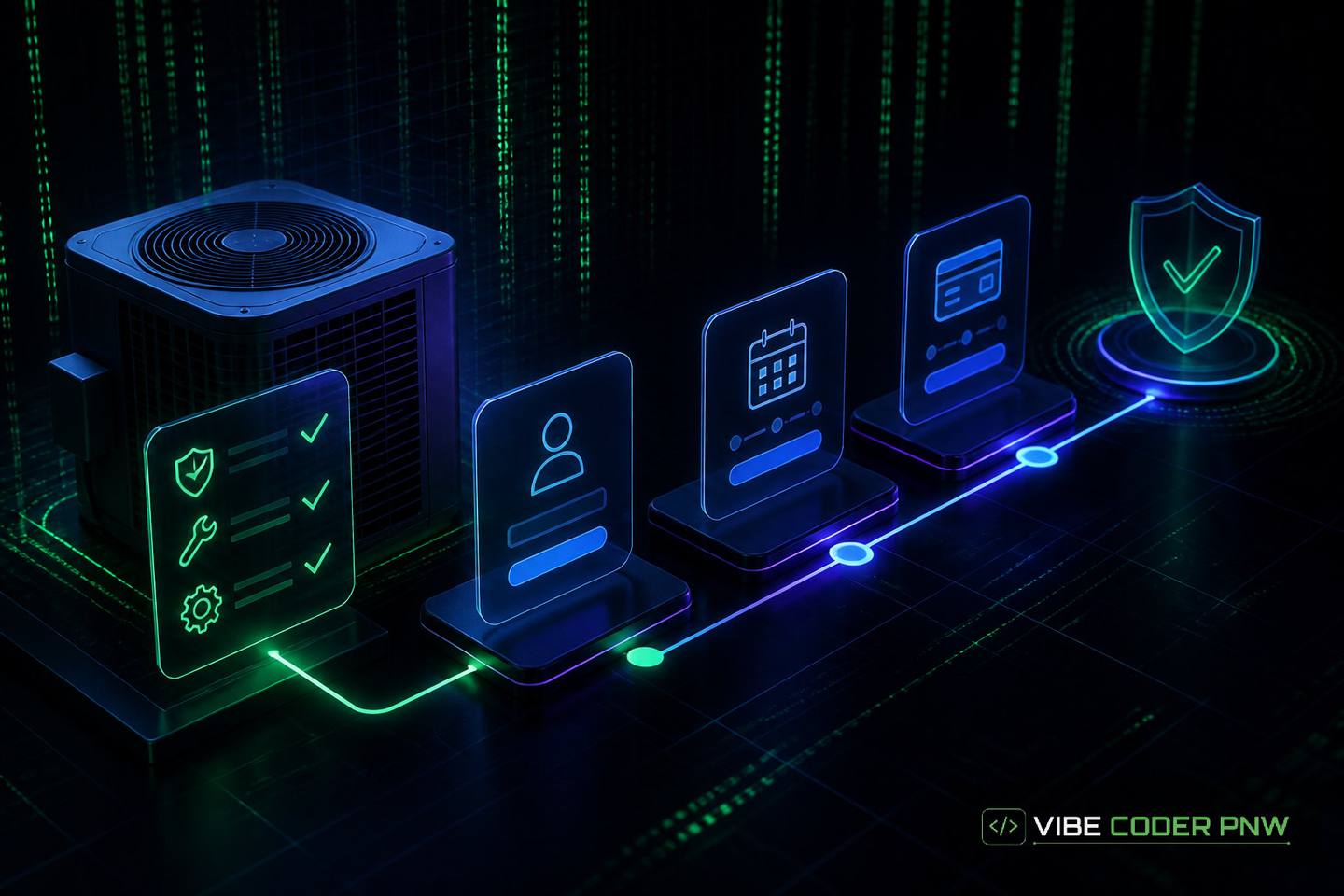
HVAC Maintenance Plans: Building the Signup and Renewal Flow Online
Learn how automated signup flows and recurring billing protect seasonal revenue while eliminating manual contract chasing for heating and cooling companies.
// key_takeaways
Key Takeaways
- Payment tokenization converts credit card details into secure digital tokens, allowing HVAC businesses to bill recurring maintenance plans without storing raw financial data.
- Connecting online signup forms directly to dispatch software via application programming interfaces eliminates manual data entry errors and updates technician records in real time.
- Requiring homeowners to create full portal accounts causes high checkout abandonment, whereas single page mobile checkout forms significantly increase agreement completion rates.
- Manual paper maintenance renewals cause dropped coverage, wasted billable technician hours, and unstable cash flow during shoulder seasons between summer and winter.
- Automated billing reminders and payment recovery retries prevent accidental service lapses when customer credit cards expire or fail to process.
Heating and cooling technicians perform routine spring and fall tune-ups to keep residential equipment running cleanly. Homeowners sign seasonal maintenance agreements to get priority scheduling, discounted parts, and predictable yearly inspections.
Implementing dedicated hvac maintenance plan software gives homeowners a simple way to sign contracts and pay online while automating yearly billing cycles. Custom agreement workflows securely store payment credentials, sync customer records, and remove administrative tasks from field staff. By automating subscription signups, heating and cooling businesses build reliable recurring revenue that fills seasonal schedule gaps.
Why Manual HVAC Plan Renewals Bleed Recurring Revenue
Paper maintenance contracts create friction at every stage of the customer relationship. Technicians hand physical copies to homeowners, collect paper checks, or ask office staff to call customers for credit card details.
These traditional steps delay activation and lead to missed renewal deadlines. Customers forget to mail checks back, while office managers spend hours chasing uncollected fees.
Rising overhead makes manual renewal calls unprofitable for field operations.
Bureau of Labor Statistics data highlights the growing labor expenses in technical field services. Spending skilled staff hours on phone calls for payment updates directly lowers operating profit margins.
- High customer drop-off: Homeowners set paper renewal forms aside and forget to sign them before the season changes.
- Wasted technician time: Field workers spend billable hours writing out paper agreements instead of completing system maintenance.
- Unpredictable cash flow: Delayed renewals leave service schedules empty during mild shoulder months between summer and winter.
Paper-based processes also make record keeping difficult for growing companies. Physical forms get lost in service vans or sit in inbox piles waiting for manual entry.
When customer credit cards expire, staff must manually call homeowners to request updated payment details. This awkward interaction creates unnecessary churn when customers decide to drop coverage rather than complete a manual phone payment.
Automating agreement renewals protects operational profitability across every service season.
Automating these steps stabilizes recurring income and keeps seasonal maintenance schedules full throughout the year. Similar efficiency gains appear when service companies use specialized scheduling tools to manage recurring maintenance agreements.
Why Do Standard Field Service Apps Fail at Renewals?
Standard field service software fails at renewals because customer portals require difficult account creation steps, lack card retry features, and treat maintenance agreements as static documents. Generic apps miss automated payment processing tools that convert past field visits into active recurring maintenance subscriptions.
Account Creation Barriers Destroy Conversion
Most standard field management applications require customers to create a full account before purchasing a plan. Homeowners must select a password, confirm an email link, and answer multiple security prompts just to buy a maintenance agreement.
Every extra form field drops completion rates by measurable percentages. Customers who simply want to pay for yearly furnace checkups abandon complicated portal logins.
Streamlined intake forms significantly increase checkout completion rates across all devices.
Google Search Central documentation confirms that minimizing checkout steps improves web conversion rates and user engagement. Subscription platforms built for service contractors eliminate registration barriers by combining agreement selection and payment intake into one smooth mobile screen.
Weak Payment Recovery Systems
Off-the-shelf dispatch platforms often lack automatic payment retries. When a credit card charge fails, the software simply flips the agreement status to inactive without warning the team.
Manual billing oversight causes unnecessary customer cancellation across home service contracts. Without an automated recovery sequence, your staff must discover failed payments weeks after they happen.
Automated recovery sequences catch payment issues before coverage lapses.
Dedicated billing tools send instant update links directly to the customer when a payment attempt fails. Similar recovery principles power high-volume personal trainer booking tools that handle recurring monthly training memberships.
| Feature Area | Generic Field Service Apps | Custom Renewal Engines |
|---|---|---|
| Checkout Speed | Multi-page portal account creation | Single-page direct payment flow |
| Payment Recovery | Manual phone calls after failures | Automated smart retries and update SMS |
| Tier Flexibility | Rigid monthly or annual presets | Custom billing frequencies and perks |
| Field Integration | Isolated portal records | Instant real-time CRM updates |
Inflexible software restricts how you package your service plans. Standard tools force contractors into fixed pricing structures that do not support custom billing schedules or tier upgrades.
Designing an Automated HVAC Signup and Renewal Engine
A web-based agreement engine gives customers a quick checkout experience on mobile phones, tablets, or desktop computers. The checkout form asks for essential property details, equipment age, and plan selection on one fast screen.
Integrating an online booking widget directly onto your main site lets homeowners add a maintenance agreement during initial emergency call bookings. This capture method turns one-time repair customers into long-term subscribers before the technician arrives at the home.
Performance standards ensure rapid form load times on mobile networks.
According to web.dev performance guidance, fast-loading web forms significantly lower user drop-off during mobile transactions. Mobile optimization ensures homeowners complete signups effortlessly while standing in their utility rooms with field technicians.
Vaulted Payments and Tokenization
Secure recurring billing relies on payment tokenization. Tokenization is a security method that converts credit card details into a randomized string of characters called a token.
Think of tokenization like checking a coat at a venue. You hand over your heavy jacket and receive a small plastic claim tag.
Digital claim tokens allow secure recurring charges without storing raw card numbers.
The venue keeps your jacket locked safely inside a secure coatroom, while you carry only the plastic tag. When it is time to charge for the next seasonal checkup, your server presents that digital tag to the payment provider without ever storing actual card details on your web host.
Automated Notifications and Pre-Season Reminders
Automated workflows send timely updates before seasonal billing events take place. Homeowners receive simple SMS and email reminders two weeks before an automatic billing charge processes.
- Advance billing notice: Homeowners get an email reminder ten days before the annual payment processes.
- Payment confirmation: System sends an instant digital invoice receipt with a link to pick a service date.
- Automated booking prompt: System sends a calendar booking link so the customer reserves their tune-up slot.
This clear communication eliminates billing surprises and chargebacks. Customers feel informed and appreciate the easy scheduling process.
Similar setup principles apply to online agreement workflows, where customers expect instant verification and effortless renewal options. Building clear digital checkout steps ensures low customer churn and predictable recurring revenue.
Connecting Online Agreements Directly to Field Dispatch Tools
An online agreement signup engine must connect directly to your dispatch and customer relationship management software. Manually rekeying online signups into office dispatch calendars creates data errors and duplicates customer profiles.
When a customer completes a signup form online, an application programming interface sends payment and property details straight into your core office database. An application programming interface, or API, is a set of rules that lets different software programs talk to each other and exchange information automatically.
Structured data transfers move agreement records instantly into dispatch queues.
MDN Web Docs explains how modern web APIs use structured JSON payloads to transmit customer data securely between servers. Using standardized API patterns ensures customer records transfer accurately without losing contact numbers or billing history.
Automatic Invoice Generation
Automated workflows create recurring invoices inside your accounting system as soon as payment clears. The system marks the invoice as paid, attaches the payment reference token, and emails the customer a PDF receipt.
W3C web standards govern how web forms transmit this data cleanly across devices. Using standard data layouts prevents missing customer phone numbers or incorrect property addresses during transfer.
Standardized markup improves search accessibility and form auto-fill accuracy.
Applying Schema.org vocabulary to your service pricing pages helps search engines recognize your maintenance plans and display rich result snippets in local search listings. Clear structured markup makes service options easier for prospective customers to discover online.
Real-Time Status Updates for Field Technicians
Field staff need immediate visibility into customer plan details while standing on a job site. Local service dispatch automation passes active plan badges directly onto mobile job tickets inside your field service app.
When a field worker opens a job ticket, clear badges show whether the homeowner has an active plan:
- Active Plan Member: 15% discount on replacement parts applied automatically.
- Priority Status: Guaranteed 24-hour response window for emergency calls.
- Tune-Up Status: Fall heating checkup remaining for the current contract year.
This instant clarity lets technicians apply accurate contract discounts without calling office dispatch to verify coverage. Technicians can also sell plan upgrades on job sites using mobile checkout screens.
Automated software database updates ensure that any address changes or card updates completed by the customer reflect instantly across both office and field devices.
What Security Risks Come With Storing Customer Card Data?
Storing customer card data introduces significant security compliance duties, data breach risks, and liability for service contractors. Unprotected billing databases expose sensitive cardholder numbers to cyberattacks. Using tokenized payment vaults ensures that raw financial data never touches your web host while keeping subscription workflows fully compliant with payment security rules.
Handling payment security correctly requires tokenized vaults so raw credit card numbers never touch your website database server.
Encryption protocols safeguard payment transmissions against unauthorized access.
NIST cybersecurity guidance emphasizes using strong encryption protocols when handling customer transactions online. Encrypting data scrambles plain text into unreadable code during transmission so unauthorized parties cannot intercept payment information.
Following OWASP application security guidance protects custom web intake forms from automated security scans and malicious form submissions. Following established security practices keeps your operations safe and protects client relationships.
Automated card maintenance keeps recurring subscription billing active.
Managing Card Failures and Expirations
Credit cards expire, get cancelled, or hit credit limits over time. Your agreement engine needs automated card recovery workflows to keep coverage active without manual intervention.
- Account updater services: Payment gateways automatically fetch updated card numbers and expiration dates from credit card networks.
- Smart retry logic: Failed charges retry automatically on specific days of the week when bank approvals are highest.
- Self-service update portals: SMS messages contain secure, direct links where homeowners update expired payment cards in seconds.
These automated steps fix failed payments quietly behind the scenes. Your team spends less time handling payment issues and more time serving customers.
Online Cancellation and Contract Terms
Clear online cancellation workflows prevent credit card chargebacks and disputes. Providing a transparent way to pause or cancel agreements builds long-term customer trust.
The online agreement portal must display active terms, past billing history, and straightforward cancellation request forms. Clear terms prevent customer misunderstandings about included tune-ups or multi-year commitment rules.
How Do You Choose the Right HVAC Software Architecture?
Choosing the right software architecture requires comparing off-the-shelf plugins against dedicated custom web applications based on drop-off rates and integration needs. Custom portals connect directly to your payment gateway and customer database, ensuring full control over subscription workflows without paying third-party platform fees.
Comparing Software Approaches
Contractors often start with generic form plugins or simple off-the-shelf software tools. While fast to set up, basic plugins struggle with complex recurring billing logic, card updater features, and deep CRM sync.
Custom web apps give you full control over the checkout layout, payment steps, and integration hooks. You build an agreement flow tailored specifically to your exact pricing tiers and field service processes.
Demographic shifts support online self-service contract management.
U.S. Census Bureau data shows that modern homeowners overwhelmingly prefer digital self-service options over scheduled phone calls for routine home maintenance billing. Offering flexible web signups aligns your HVAC contracting business with modern consumer expectations.
Auditing Your Current Signup Process
Before building new billing workflows, audit your current signup process to identify manual touchpoints that slow down conversions.
- Count manual steps: Track how many phone calls or emails it takes to process one paper agreement.
- Measure activation delays: Calculate how many days pass between initial customer contact and first payment.
- Identify drop-off points: Check where customers stop responding during paper or portal renewal requests.
Eliminating manual barriers increases agreement conversions and stabilizes recurring cash flow across all seasons.
Building Your Subscription Engine
Building a custom agreement workflow requires mapping customer intake steps, gateway vault setups, and dispatch database sync points. Dedicated platforms eliminate subscription management overhead while delivering a fast, branded checkout experience for your home services business. One-time setup fees start at $199 to $399, depending on complexity and security requirements.
Partnering with experienced software developers ensures your recurring payment architecture remains reliable, PCI-compliant, and fully integrated with your daily operations. To scope a custom maintenance plan portal built around your service workflow, reach out to Vibe Coder PNW and start your project intake.
Final takeaway
Managing HVAC renewals on paper is like asking coffee shop regulars to fill out a fresh paper membership form every time they buy a monthly refill pass. An automated online checkout system acts like a modern windshield toll pass that handles payment silently in the background. Homeowners stay covered without filing paperwork, and technicians keep their seasonal schedules consistently full.
- Paper maintenance contract renewals delay payments, waste billable technician hours, and cause unnecessary customer cancellation.
- Complicated portal signups drop checkout completion rates, while single-page intake forms boost mobile sales.
- Automated recurring billing engines protect subscription revenue through smart payment retries and direct dispatch synchronization.
// frequently_asked
Questions and Answers
// reference
Cite this guide
- Title
- HVAC Maintenance Plans: Building the Signup and Renewal Flow Online
- Author
- Bojack Semaj
- Published
- URL
- https://vibecoderpnw.com/blog/hvac-maintenance-plans-building-the-signup-and-renewal-flow-online
- Website
- Vibe Coder PNW
Suggested citation
Bojack Semaj. “HVAC Maintenance Plans: Building the Signup and Renewal Flow Online.” Vibe Coder PNW, published October 18, 2026. https://vibecoderpnw.com/blog/hvac-maintenance-plans-building-the-signup-and-renewal-flow-online.
// related_on_this_site
// comments
0 comments
// keep_reading
Should a Service Business Use a Booking Widget or a Call Button?
Discover whether your service company should use online calendar widgets, phone call buttons, or a flexible hybrid intake system to convert more website visitors.
read →[ Local Business ]Booking, Rescheduling, and No-Shows: Scheduling Software for Personal Trainers
Learn how modern booking automation stops late cancellations, keeps your training slots full, and protects your daily fitness income without manual texting.
read →[ Local Business ]Septic Service Scheduling: Route Density, Reminders, and Recurring Work
Discover how smart route density, automated maintenance reminders, and organized dispatching help septic business owners cut travel costs and secure steady recurring revenue.
read →